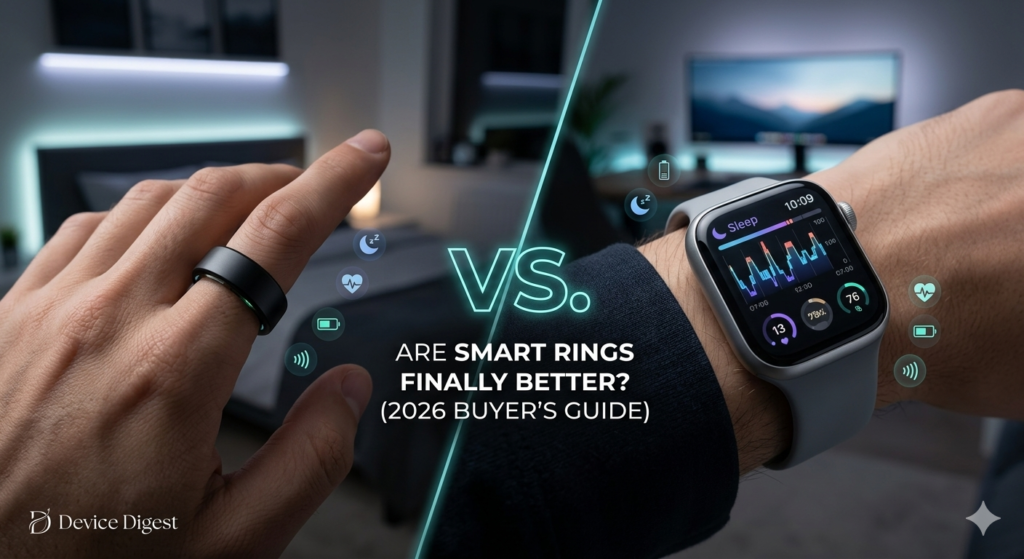
If you have ever tried to get a good night’s sleep while wearing a bulky, glowing smartwatch, you already know the struggle. You wake up with a dead battery, an uncomfortable indentation on your wrist, and data that tells you that you tossed and turned all night—which you already knew, because your watch kept waking you up.
In 2026, wearable health tech has shifted. Consumers are exhausted by subscription fees and tired of wearing mini-smartphones to bed. Enter the smart ring.
But are smart rings actually accurate enough to replace your trusty smartwatch, or are they just an expensive trend? Here is everything you need to know about the smart ring vs. smartwatch debate in 2026, including the best subscription-free options you can buy right now.
Smart Rings vs. Smartwatches: The 2026 Showdown
Before you ditch your wrist wearable, it is important to understand that rings and watches serve completely different purposes. A smartwatch is an active companion; a smart ring is a passive observer.
Here is how they stack up in the areas that matter most:
1. Comfort & Wearability (Winner: Smart Rings)
Comfort is the biggest dividing line. A smartwatch sits on a moving joint and is impossible to ignore. For 24/7 tracking—especially sleep tracking—a ring is drastically superior. Most modern smart rings weigh between 2 and 4 grams and are practically unnoticeable once you put them on.
2. Data Accuracy During Sleep (Winner: Smart Rings)
You might assume a larger watch holds better sensors, but rings have a biological advantage. The arteries in your fingers are closer to the skin surface and have a much denser capillary network than your wrist. This gives the photoplethysmography (PPG) sensors in a smart ring a much cleaner heart rate and blood oxygen signal with less ambient noise.
3. Workouts & Real-Time Data (Winner: Smartwatches)
This is where smart rings fall short. If you are a runner who needs real-time pace data, or a weightlifter gripping heavy barbells (which can scratch a smart ring), you still need a smartwatch. Rings are built for recovery, not active performance tracking.
4. The Hidden Cost: Subscriptions
The biggest complaint about the wearable market right now is the “subscription trap.” Devices like the Oura Ring 4 require a $5.99/month fee just to see your own health data. Over two years, that adds up quickly. Fortunately, 2026 has brought incredible rings that require zero monthly fees.
Top 3 Subscription-Free Smart Rings You Can Buy Today
If you want the benefits of a smart ring without being locked into a monthly payment, these are the top three devices currently leading the market.
1. Ultrahuman Ring Air (Best Overall)
The Ultrahuman Ring Air is currently the best all-around alternative to Oura. It is incredibly light (starting at 2.4g) and focuses heavily on recovery and metabolism.
- What users love: The “circadian alignment” features tell you exactly when you should get sunlight, drink coffee, or wind down based on your unique biometric data.
- Battery Life: Up to 8 days.
- Best for: Biohackers and health optimizers who want deep, actionable data.
👉 [Check the Current Price https://amzn.to/44eSNTg]
2. RingConn Gen 2 Air (Best for Sleep Tracking)
At just 2.3mm thick, the RingConn Gen 2 Air is one of the slimmest rings on the market. It focuses purely on long-term health metrics and detailed sleep staging.
- What users love: It comes with a portable charging case (similar to wireless earbuds) that holds multiple full charges, meaning you rarely need to plug it into a wall.
- Battery Life: Up to 8 days (plus multiple case charges).
- Best for: Anyone specifically looking to cure their sleep issues and track sleep apnea risks.
👉 [Check the Current Price https://amzn.to/4uGGqKr]
3. Amazfit Helio Ring (Best Budget Option)
Amazfit has a reputation for disrupting the fitness tracker market with high quality at lower prices, and the Helio Ring is no exception. At a fraction of the cost of premium rings, it delivers all the core metrics you need.
- What users love: It integrates perfectly with the Zepp app and works flawlessly alongside other Amazfit watches if you choose to wear both.
- Battery Life: Up to 4 days.
- Best for: First-time buyers who want to try a smart ring without a massive upfront investment.
👉 [Check the Current Price on Amazon https://amzn.to/4v4hexX]
Best Smartwatch Alternatives (For the Traditionalists)
Decided a ring isn’t for you? If you still prefer a wrist-wearable but want something sleek enough to wear to bed, skip the bulky high-end models and look at these lightweight alternatives.
- Garmin Venu Sq 2: Excellent battery life (up to 11 days), brilliant AMOLED screen, and Garmin’s legendary “Body Battery” recovery metric. [Check Price on Amazon https://amzn.to/4uQFaVf]
- Fitbit Inspire 3: An ultra-minimalist fitness band that is so light you will forget it is there. It provides fantastic sleep tracking without the bulk of a full watch face. [Check Price on Amazon https://amzn.to/4eQkbNo]
The Final Verdict: Which Should You Buy?
If your main goal is sleep optimization, recovery tracking, and 24/7 health monitoring, buy a smart ring. The comfort and biometric accuracy from the finger cannot be beaten, and choosing a subscription-free model like the Ultrahuman Ring Air makes it a smart long-term investment.
If you are an active athlete who needs GPS tracking, on-screen notifications, and real-time workout stats, stick with a smartwatch.